
2026/10/22 · 17 views
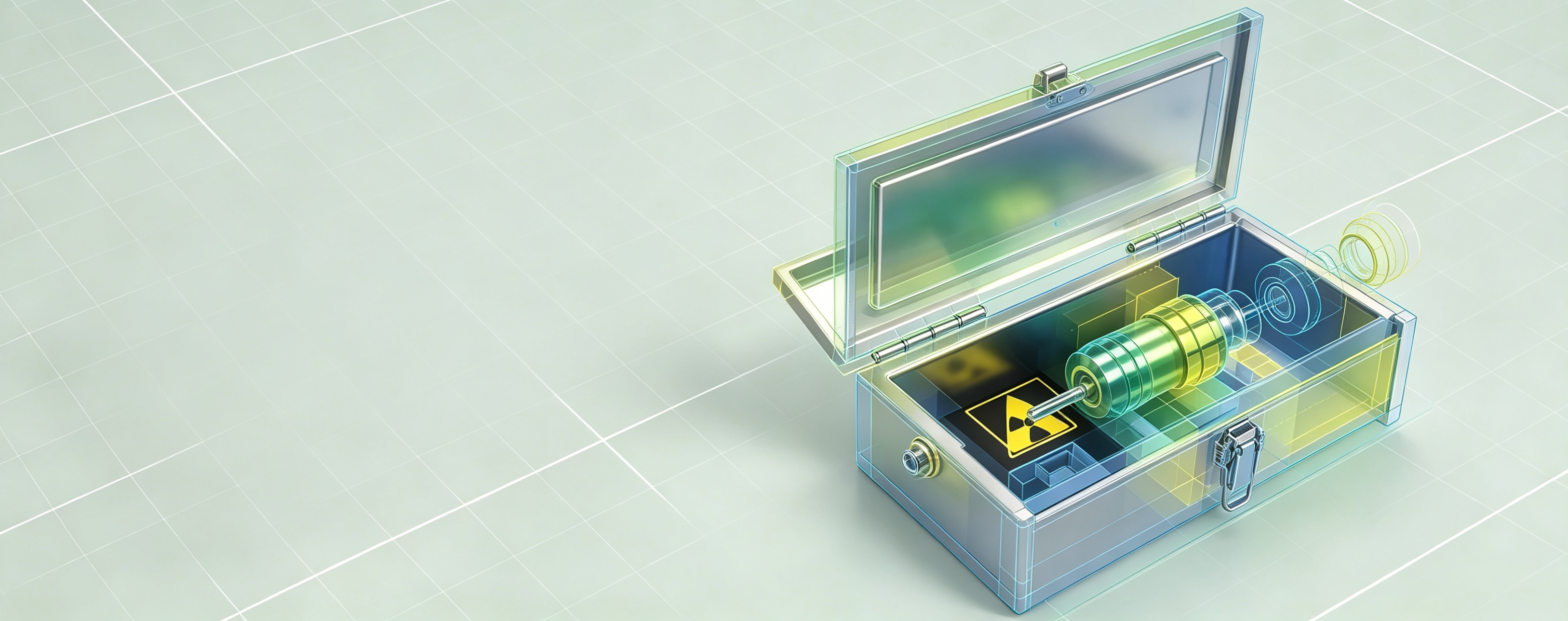
This guide explains how to choose suitable lead equivalence (mmPb) shielding for radiopharmacy compounding, dispensing and storage. It covers core concepts of mmPb, HVL, shielding differences for gamma and beta emitters such as F-18, Ga-68, Tc-99m and Y-90, tungsten-to-lead equivalence conversion, bremsstrahlung risk control, and practical selection guidance. It also introduces APEX radiopharmacy shielding products, including tungsten syringe shields, lead equivalent storage containers and radiation protective garments to help labs meet radiation safety and ALARA requirements.
Why "mmPb" is the first question every radiopharmacy buyer should ask
Walk into any hot lab and you will see the same conversation happening on the supply manager's desk: "We need a new syringe shield — which mmPb?" The answer is never "the thickest one on the catalog." Too little and your technologists blow through extremity dose limits (500 mSv/year, ICRP/NRC). Too much and the shield becomes so heavy that staff skip using it — the single most common ALARA failure in nuclear medicine.
Lead equivalence (written mmPb, mm-Pb or Pb-eq) is the universal language of radiation shielding. It tells you: *"this object attenuates gamma and X-ray radiation exactly as well as a sheet of pure lead of this thickness."* Because tungsten, leaded glass, depleted uranium and polyethylene all attenuate differently, mmPb lets an engineer in Düsseldorf, a hot pharmacist in São Paulo and a procurement officer in Riyadh compare products on the same number.
This guide walks you through the physics, the radionuclide-by-radionuclide reference table, and the five questions that lock in the correct mmPb for your workflow — and shows where APEX tungsten and lead shielding products fit.
1. What actually is lead equivalence?
Lead equivalence (mmPb) is the thickness of solid lead that produces the *same radiation attenuation* as your shielding material, at the photon energy you actually use.
Two numbers drive it:
* HVL — Half-Value Layer: the thickness that cuts radiation to 50%.
* TVL — Tenth-Value Layer: the thickness that cuts it to 10% (one order of magnitude).
For example, at the 511 keV annihilation photopeak of F-18 / Ga-68 / Cu-64, the HVL in pure lead is about 4.1 mm and the TVL is about 13.5–15 mm. That means:
* 1 TVL of lead ≈ 90% attenuation.
* 2 TVLs ≈ 99%.
* 3 TVLs ≈ 99.9%.
A 50 mm lead shipping vial for F-18 delivers roughly 12 HVL — about 99.97% attenuation — which is why Type A packaging for F-18 routinely ships in 50 mm Pb.
|
Critical caveat: mmPb is energy-specific. A shield rated "10 mmPb at 140 keV" is *not* 10 mmPb at 511 keV. Always ask the manufacturer at which photon energy the lead equivalent was certified. |
2. The 5 factors that determine your mmPb
Factor 1 — Gamma energy of the radionuclide
Higher-energy photons need dramatically more shielding. The classic textbook jump is Tc-99m (140 keV) to F-18 (511 keV): the lead TVL goes from roughly 0.3 mm to \~14 mm — a 40× increase in required wall thickness for one TVL of protection.
Factor 2 — Activity you handle
A 1.11 GBq (30 mCi) patient dose of F-18 needs a different vial shield than a 37 GBq (1 Ci) bulk shipment arriving from the cyclotron. Double the activity, you effectively need one more HVL of shielding to hold dose rate constant.
Factor 3 — Distance and time
The inverse-square law still wins. Moving a syringe shield from 5 cm to 30 cm from your body cuts dose by 36×. That is why long-handled shielded syringe carriers (like the APEX / Saxsons-style multi-syringe carriers) often buy you more ALARA margin than adding another 6 mm of lead.
Factor 4 — Extremity vs whole-body dose
Hands receive 10–50× the dose of the torso during dose draw. The extremity limit (500 mSv/year) is what governs syringe-shield choice, not the whole-body limit (20 mSv/year). A tungsten syringe shield during F-18 drawing reduces hand dose by 90–99%.
Factor 5 — Beta emitters need a two-step shield
Pure beta emitters (Y-90, Sr-90, P-32) produce bremsstrahlung when they hit lead directly. You must line the inside with acrylic/perspex (3–5 mm) to absorb the beta first, then let lead or tungsten handle the resulting X-rays. A "β-γ hybrid" shield is mandatory here — a solid lead-only shield makes the problem worse.
3. Quick-reference: recommended mmPb by radionuclide
Use this table as your starting point; your medical physics team should still verify against your room layout and workload.
|
Radionuclide |
Main photon energy |
Syringe shield |
Vial / shipping pot |
Hot-cell / L-block wall |
|
Tc-99m (SPECT) |
140 keV |
2 mm W (≈ 2.5 mmPb) |
3–6 mm Pb |
25 mm Pb |
|
I-123 / In-111 |
159–245 keV |
3 mm W (≈ 3 mmPb) |
6–9.5 mm Pb |
25 mm Pb |
|
I-131 (therapy) |
364 keV |
6 mm W (≈ 6 mmPb) |
10–12 mm Pb |
50 mm Pb |
|
Lu-177 |
113 + 208 keV + β⁻ |
6 mm W + acrylic liner |
10–15 mm Pb |
50 mm Pb |
|
F-18 / Ga-68 / Cu-64 (PET) |
511 keV annihilation |
8 mm W (≈ 8–10 mmPb) |
30 mm Pb / equivalent W |
50 mm Pb (≈ 12 HVL) |
|
Zr-89 |
909 keV |
10 mm W |
40 mm Pb |
75–100 mm Pb |
|
Y-90 / P-32 (β⁻ only) |
Bremsstrahlung |
β-γ hybrid: 3 mm acrylic inside + 6 mm W outside |
Hybrid lead pot + acrylic insert |
L-block with acrylic face |
Source basis: NCRP 151 / ICRP recommendations, Saxsons and DRPS hot-lab design references, and real-world Type A packaging filings (F-18 in 50 mm Pb, Ga-68 in 30 mm Pb, Zr-89 in 40 mm Pb, Tc-99m in 3 mm Pb).
4. Lead vs tungsten: why mmPb still matters
You will see tungsten alloy (WHA, \~90–97% W with NiFe/NiCu binder) marketed as "lead-free" or "non-toxic." The density numbers look impressive: tungsten alloy runs 17.0–18.8 g/cm³ versus pure lead at 11.3 g/cm³ — roughly 1.6× denser.
Practically, that means:
* A 5 mm tungsten syringe wall ≈ 5.5 mmPb of lead equivalent.
* A 2–8 mm tungsten syringe family ≈ 2.5–5.5 mmPb, attenuating >99% of gamma rays.
* At 1 MeV gamma, the HVL of tungsten is \~0.35 cm versus \~0.89 cm for lead.
So why does the industry still quote mmPb instead of "mm of tungsten"? Because:
Regulators and physicists think in Pb-eq.
A tungsten part at 8 mm is *not* automatically 8 mmPb — the alloy composition and binder fraction shift the equivalence by ±15%.
Leaded glass windows (used in viewports) are specified separately and need 7–9 mm of leaded glass to match 2 mm of tungsten.
APEX product note: APEX Medical Solutions machines its tungsten shielding (syringe shields, vial shields, dose calibrator ducts) from high-density WHA billets and certifies each SKU with a measured mmPb rating at the relevant photopeak — not a density-derived estimate. Ask for the test report with any quotation.
5. The hidden trap: beta emitters and bremsstrahlung
If you run a theranostics program (Lu-177, Y-90 DOTATATE/DOTATOC, Ac-225 daughters), this section is where most procurement mistakes happen.
When a high-energy beta (Y-90 endpoint 2.28 MeV) slams into a high-Z material like lead or tungsten, it emits bremsstrahlung X-rays — and you have just turned your shield into an X-ray source aimed at your staff.
The correct construction order:
Inner layer: 3–5 mm acrylic or polycarbonate — stops the beta particles.
Outer layer: lead or tungsten — attenuates the resulting bremsstrahlung.
A 5 mm tungsten shield actually outperforms 10 mm acrylic alone for Y-90, but only when the acrylic liner is present. APEX ships its β-γ hybrid syringe shields and vial pots with a permanently bonded acrylic insert for exactly this reason.
6. How APEX maps to your mmPb decision
Rather than selling you "the biggest shield," APEX Medical Solutions matches product tier to the radionuclide on your bench:
|
Your workflow |
APEX product family |
Typical mmPb / wall |
|
Routine SPECT, Tc-99m elutions |
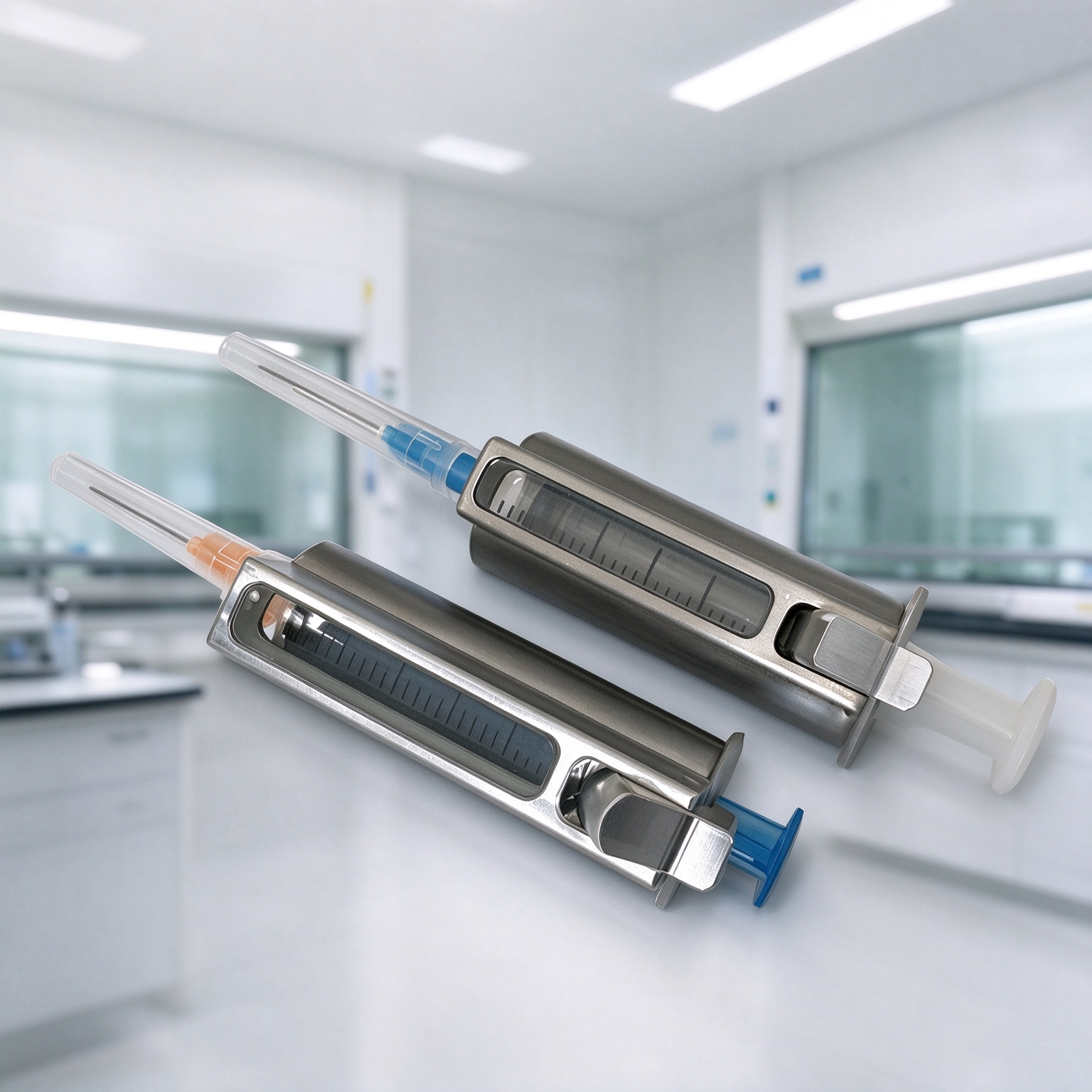
APEX Tungsten Syringe Shield, 2–3 mm wall |
≈ 2.5–3 mmPb |
|
High-volume F-18 / FDG PET dose draw |
APEX Tungsten Syringe Shield, 8 mm wall, leaded-glass window |
≈ 8–10 mmPb |
|
I-131 capsule & Lu-177 therapy dispensing |
APEX Lead Vial Shield, 10–12 mm Pb |
10–12 mmPb |
|
Bulk F-18 / Ga-68 arrival from cyclotron |
APEX Tungsten / Lead Shipping & Storage Pots |
30 mm Pb equivalent |
|
Y-90 / P-32 / Sr-90 therapy |
APEX β-γ Hybrid Syringe & Vial Shields |
acrylic liner + 6 mm W outer |
|
Hot-lab staff protection at the bench |
APEX L-Bench / L-block |
25–50 mm Pb |
|
Transport between hot lab and injection room |
APEX Multi-syringe Shielded Carrier |
3 / 6 / 12 mm Pb tiers |
|
Staff wear during therapy patient care |
APEX Lead & Lead-Free Aprons, Thyroid Collars, Leaded Eyewear |
0.25 / 0.35 / 0.5 mmPb |
APEX Radiation Shielding Products
All APEX shielding is manufactured in cGMP-controlled facilities and supplied with Type A (UN) packaging certification for O-18 water, F-18 and Ga-68 shipments where required.
7. A practical decision checklist
Before you issue a purchase order, your physicist should confirm:
* Photopeak of the dominant gamma (140? 364? 511? 909 keV?).
* Max activity you will ever handle in one object (GBq).
* Distance from the shield to the nearest worker at the worst moment.
* Occupancy factor of the area behind the shield.
* Is the source a beta emitter? → acrylic liner required.
* Is the mmPb rating certified at YOUR photopeak, not just at 100 kVp X-ray?
* Mass and ergonomics — will staff actually pick it up every dose?
* Regulatory filing — Type A packaging, Anvisa / FDA / CE / CNEN documentation needed?
If any box is unchecked, stop the order and loop in your medical physics team.
Frequently Asked Questions
Q1. What mmPb syringe shield do I need for F-18 FDG?
Use a tungsten syringe shield of 8 mm wall thickness (≈ 8–10 mmPb equivalent). A 5 mm tungsten shield is the minimum for routine PET; 8 mm is preferred for high-activity draws and reduces hand dose by 90–99%.
Q2. What is the difference between mmPb and mm of tungsten?
mmPb is the lead-equivalent attenuation. Tungsten is \~1.6× denser than lead, so a 5 mm tungsten wall typically equals ≈ 5.5 mmPb — but the exact number depends on the alloy binder fraction and must be certified at your photon energy.
Q3. How much lead do I need for an F-18 shipping vial?
Routine Type A shipments of F-18 use 30–50 mm of lead (or equivalent tungsten). At 511 keV the lead TVL is \~14 mm, so 30 mm Pb ≈ 2 TVL ≈ 99% attenuation at the surface.
Q4. Can I use a lead syringe shield for Y-90?
No — not without an acrylic inner liner. Direct beta-on-lead creates bremsstrahlung. Use a β-γ hybrid shield (3–5 mm acrylic inside, lead or tungsten outside).
Q5. What does ALARA mean for radiopharmacy shielding?
ALARA = "As Low As Reasonably Achievable." You choose shielding such that staff whole-body dose stays well under 20 mSv/year and extremity dose under 500 mSv/year, without making equipment so heavy that staff abandon it.
Q6. Is tungsten safer than lead?
Tungsten is non-toxic, thinner for the same mmPb, and mechanically stronger. Lead remains cheaper and easier to cast into large hot-cell walls. Both are valid — mmPb is the spec that compares them fairly.
Q7. Where can I buy APEX mmPb-certified radiopharmacy shielding?
APEX Medical Solutions (operated by Huayi-Isotope) supplies tungsten syringe shields, lead vial shields, β-γ hybrid pots, shielded carriers, lead aprons and Type A shipping containers globally. Request a quote with your radionuclide and activity — APEX's physicists will recommend the correct mmPb tier.
Bottom line
Choosing mmPb is not a guess. It is a physics calculation driven by photon energy × activity × distance × time, and then expressed in a number everyone in the supply chain can read: millimeters of lead equivalent. Pick too thin and you burn out your technologists' hands; pick too thick and the shield never leaves the drawer.
Start from the reference table in Section 3, hand the checklist in Section 7 to your medical physicist, and ask APEX for certified mmPb test reports — not marketing claims — on every syringe shield, vial pot and hot-cell lead you buy.
Next step: Download the APEX shielding selection datasheet or request a sample syringe shield matched to your most-used radionuclide. Bring the mmPb rating, the certification photopeak, and the Type A packaging paperwork — and your next procurement meeting will be a ten-minute conversation, not a three-day argument.
This article is intended for radiopharmacy managers, medical physicists, hot-lab pharmacists and procurement teams. It is educational and does not replace a site-specific shielding survey by a qualified medical health physicist.