
2026/10/26 · 1 views
A lead apron is a lead apron — until you actually look at the photon energy it is built to stop. A radiology apron rated 0.25–0.35 mmPb is tuned to the soft scatter off a 60–120 kVp X-ray tube. A nuclear medicine technologist standing next to an FDG patient is facing 511 keV annihilation photons, where the lead HVL jumps from 0.26 mm (Tc-99m at 140 keV) to 4.0 mm (F-18). This guide explains why NM aprons are usually 0.5 mmPb minimum, why a wraparound cut beats a front-only apron for all-day wear, why the thyroid collar and leaded eyewear are non-negotiable additions that radiology departments skip, and how annual visual plus biennial fluoroscopic inspections — plus correct flat or wide-hanger storage — protect the investment. We also map APEX lead and lead-free aprons, thyroid collars and eyewear to SPECT, PET and therapy workflows.
The procurement trap: buying "radiology aprons" for a nuclear medicine department
The lead apron order comes through the purchasing portal. The catalog shows three options: lightweight 0.25 mmPb, standard 0.35 mmPb, and heavy 0.5 mmPb. The buyer picks the middle one, checks the price against last year, and moves on.
Six months later, the ring badge and collar badge reports look fine — but the whole-body badge outside the apron is creeping up, and the new technologist complains that her lower back hurts by lunch.
What happened: the department bought radiology aprons for a nuclear medicine workflow. The photon energies, the wear duration, the geometry of exposure and the missing accessories are all different. This guide unpacks the four differences that matter.
1. The photon energy difference — the whole story in two numbers
Lead attenuation is brutally energy-dependent. Two reference numbers frame the entire NM vs radiology gap:
|
Scenario |
Photon energy |
Lead HVL |
|
Radiology X-ray scatter (at the radiographer's position) |
60–120 kVp effective, ~50–80 keV |
~0.05–0.15 mm Pb |
|
SPECT — Tc-99m |
140 keV |
~0.26 mm Pb |
|
Therapy — I-131 |
364 keV |
~0.7–1.0 mm Pb |
|
PET — F-18 / Ga-68 |
511 keV annihilation |
~4.0 mm Pb |
Read that last row again. A 0.25 mmPb apron — the workhorse of radiology — is less than one HVL at 511 keV. It cuts PET dose by roughly half, not by the 90–99% everyone assumes. A 0.5 mmPb apron at 511 keV is only about 1.4 HVL — still not great, but meaningfully better.
This is why NM aprons default to 0.5 mmPb minimum, not 0.25. Radiology can get away with thinner aprons because the photons are soft; NM cannot.
2. The wear-time difference — minutes vs hours
In radiology, the technologist puts the apron on for a 5-minute fluoroscopy run, takes it off between patients, and spends most of the shift at a console behind a leaded glass booth.
In nuclear medicine, the technologist stands next to an injected patient — who is now a mobile gamma source — during uptake, imaging, injection and discharge. An NM technologist may wear the apron for 4–6 consecutive hours per shift. That changes the engineering:
Weight becomes an occupational health issue. A 5 kg apron worn for 5 minutes is fine; the same apron worn for 6 hours causes lower-back strain, missed donnings, and technologists who leave the apron in the locker "just for this one scan."
Wraparound designs win. A 0.25 mmPb front + 0.25 mmPb side wraparound gives ~0.5 mmPb protection at the front while shedding 20–30% of the weight versus a solid 0.5 mmPb front-only apron.
Lead-free / composite aprons (bismuth, antimony, tungsten-loaded rubber) trade a little bulk for 15–25% lighter weight at the same mmPb — worth the premium in high-throughput PET.
3. The missing accessories — thyroid collar and leaded eyewear
This is the second place NM departments under-buy. In radiology, the apron alone is often considered sufficient. In nuclear medicine, two additional accessories matter:
Thyroid collar
The thyroid sits on the neck, directly above the apron's collar line. Without a dedicated thyroid shield, the neck receives unattenuated gamma from every injected patient standing in front of the technologist. The thyroid is radiosensitive; ICRP has flagged it as a cancer-risk organ. A 0.25–0.5 mmPb thyroid collar clips onto the apron and closes the gap.
Leaded eyewear
ICRP 103 lowered the occupational eye-lens limit to 20 mSv/year averaged over 5 years. In PET workflows, eye doses and whole-body doses are comparable (Hp(3)/Hp(10) ≈ 0.7–1.0). Leaded glasses with 0.5–0.75 mmPb equivalent side shields reduce lens dose during close-up patient injection and bedside assistance. Standard polycarbonate safety glasses do not count — they attenuate beta, not 511 keV gamma.
Whole-body badge placement
One rule that trips up new NM hires: the whole-body TLD/OSL badge is worn outside the apron, at collar level — not inside. Inside-the-apron reading would under-estimate true effective dose, because the abdomen and pelvis receive no protection during NM work (the patient, not the X-ray tube, is the source).
4. Apron care — the failure mode nobody budgets for
A lead apron is not a t-shirt. The lead layer inside the vinyl shell cracks if folded, crushed, or dropped. A cracked apron looks fine on the outside but has invisible pinhole leaks — and the only way to find them is a fluoroscopic X-ray inspection.
Standard maintenance schedule (UK HSE / Australian / Chinese GBZ 176 practice):
Visual inspection: every 6 months — check straps, vinyl shell, flexibility.
Fluoroscopic / X-ray inspection: every 12–24 months — laid flat on an X-ray table, look for cracks, folds, foreign objects.
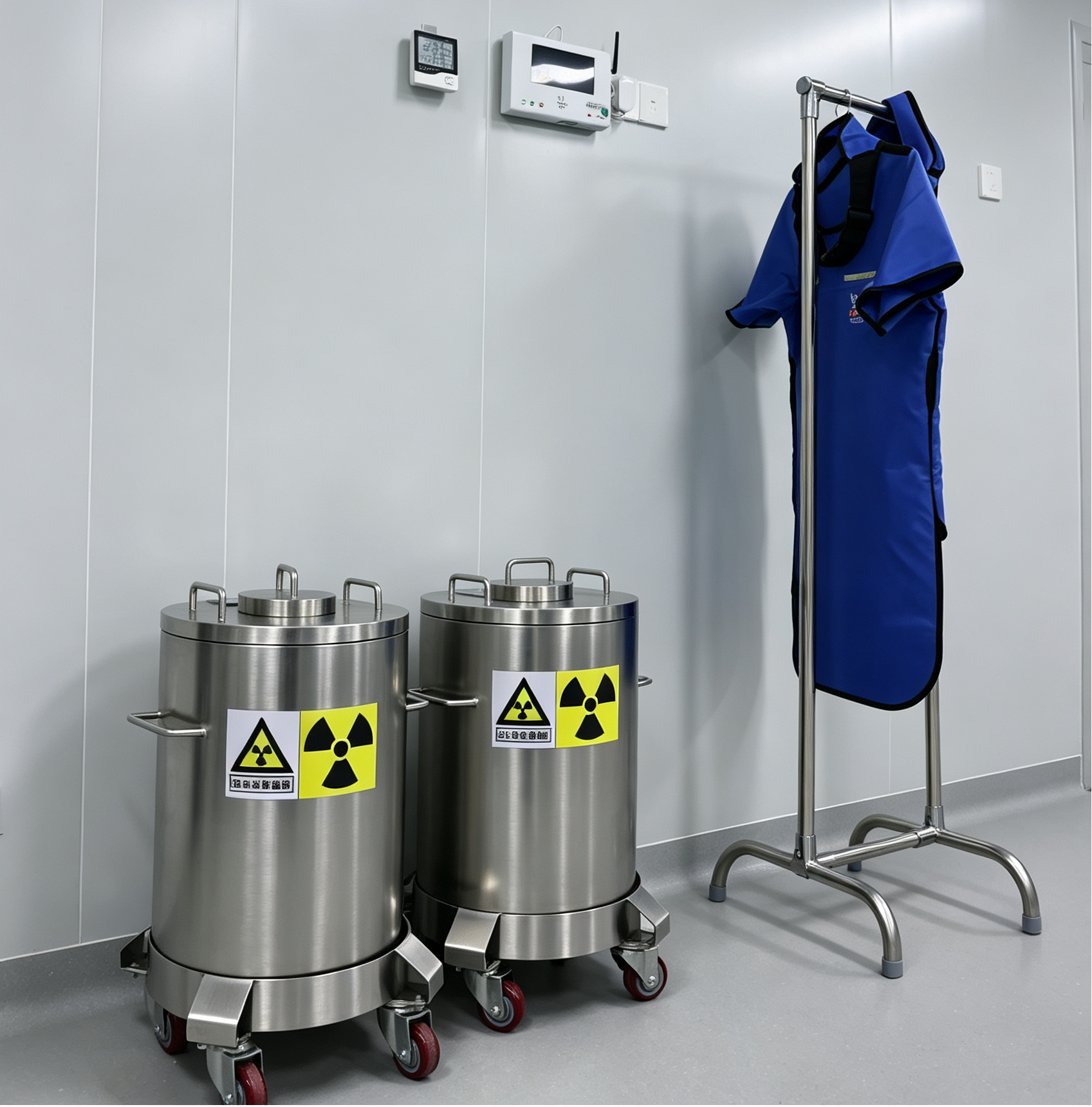
Storage: hang on a wide, rounded hanger (never folded over a hook) or lay flat. Never crumple into a locker.
Service life: typically 5 years, extendable to 6 after passing inspection. After that, retire — the lead layer fatigues.
Every apron should carry an inventory tag with purchase date, mmPb rating, and last inspection date. Joint Commission and IAEA audits will ask for this.
5. Quick reference: what to spec per workflow
|
Workflow |
Apron mmPb |
Wraparound? |
Thyroid collar |
Leaded eyewear |
|
Routine SPECT (Tc-99m) imaging |
0.35–0.5 mmPb front |
Recommended |
Yes |
Optional |
|
High-throughput SPECT / bone scan days |
0.5 mmPb wraparound |
Yes |
Yes |
Optional |
|
PET / PET-CT (F-18, Ga-68) |
0.5 mmPb minimum; 0.5 + 0.25 for heavy days |
Strongly recommended |
Yes |
Yes |
|
I-131 therapy ward rounds |
0.5 mmPb front + sides |
Yes |
Yes |
Yes |
|
Lu-177 / Y-90 therapy administration |
0.5 mmPb wraparound + apron gloves |
Yes |
Yes |
Yes |
|
Hot lab bench work (behind L-block) |
Usually not needed at the bench; needed at patient bedside |
— |
— |
— |
6. Where APEX fits
APEX Medical Solutions supplies the full apparel layer for nuclear medicine departments — not just aprons, but the accessories that actually move the dose numbers:
|
Your need |
APEX product |
|
Front-only apron, low-throughput clinic |
APEX Lead Apron, 0.25 / 0.35 / 0.5 mmPb |
|
All-day PET / therapy wear |
APEX Wraparound Apron, 0.25 front + 0.25 sides (≈0.5 mmPb at front, lighter) |
|
Weight-sensitive staff |
APEX Lead-Free Apron (bismuth / tungsten composite, 15–25% lighter) |
|
Neck protection |
APEX Thyroid Collar, 0.25 / 0.5 mmPb, clips to apron |
|
PET eye protection |
APEX Leaded Eyewear, 0.5–0.75 mmPb equivalent, side shields |
|
Hot lab hands |
APEX Lead-Rubber Gloves for syringe handling |
7. The buying checklist
Before you reorder aprons:
What photon energy is your dominant workflow? (140? 364? 511 keV?)
How many consecutive hours per shift is the apron actually worn?
Is the apron wraparound or front-only? (front-only = 0.5 mmPb minimum)
Do you have thyroid collars for every technologist?
Do PET techs have leaded eyewear?
Is the whole-body badge worn outside the apron?
Is there an annual fluoroscopic inspection program on file?
Are aprons stored on wide hangers, not folded in lockers?
Are aprons older than 5 years tagged for retirement?
Frequently Asked Questions
Q1. Can I use a 0.25 mmPb radiology apron in nuclear medicine?
For Tc-99m SPECT imaging at patient-contact distance, 0.25 mmPb is marginal. For F-18 PET and therapy work, it is inadequate — at 511 keV, 0.25 mmPb is less than one lead HVL. Spec 0.5 mmPb minimum for NM.
Q2. Why is nuclear medicine apron thickness higher than radiology?
Because NM photons are harder: Tc-99m is 140 keV and F-18 is 511 keV, versus 60–120 kVp soft X-ray scatter in radiology. Higher-energy photons need more lead to stop.
Q3. Do I really need a thyroid collar in nuclear medicine?
Yes. The neck sits above the apron line and receives direct gamma exposure from injected patients. The thyroid is radiosensitive; a 0.25–0.5 mmPb collar is standard PPE in NM.
Q4. Are lead-free aprons as good as lead aprons?
At the same certified mmPb, yes — they use bismuth, antimony or tungsten composites. They are 15–25% lighter and non-toxic, but slightly bulkier and more expensive. They are worth it for all-day PET wear.
Q5. How often should lead aprons be X-ray inspected?
Visual check every 6 months; fluoroscopic / X-ray inspection every 12–24 months. Replace immediately if cracks are found.
Q6. Where do I wear my dosimetry badge in a lead apron?
Wear the whole-body badge outside the apron at collar level. Wear a ring badge on the non-dominant hand during syringe draws. Add an eye-lens dosimeter for PET work.
Bottom line
A lead apron in nuclear medicine is a different product from a lead apron in radiology — not because marketing says so, but because the photon energy, wear duration and exposure geometry are different. Spec 0.5 mmPb minimum for NM, wraparound where the apron goes on all shift, add the thyroid collar and leaded eyewear that radiology departments skip, and run the annual fluoroscopic inspection program that catches cracked lead before it catches a technologist.
Pair the right apparel with the right bench shielding (L-blocks, syringe shields, vial shields) and the right workflow — apparel is the last 20% of dose reduction, but it is the 20% that sits directly on the technologist.
Next step: Audit your apron rack against the checklist in Section 7, and ask APEX for a package quote matched to your dominant imaging modality.