
2026/10/26 · 3 views
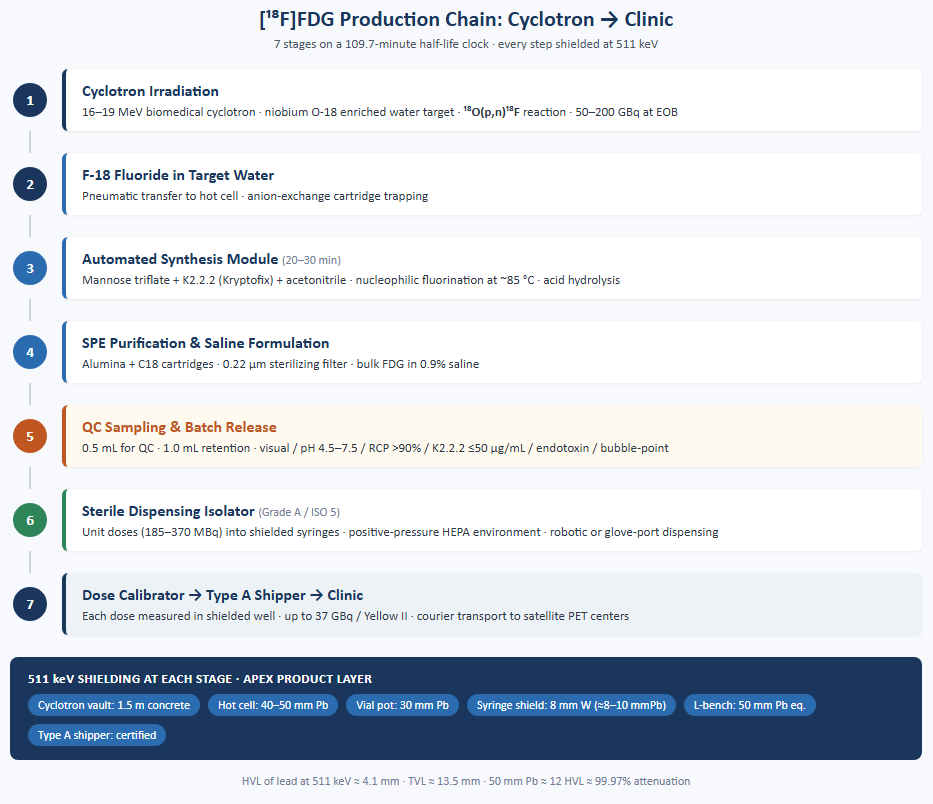
[18F]FDG is the most-produced radiopharmaceutical on Earth, and every PET radiopharmacy — whether attached to a cyclotron or dispensing commercial doses — runs the same chain: cyclotron irradiation of oxygen-18 enriched water, automated nucleophilic synthesis in a shielded hot cell, cGMP QC on a 110-minute clock, and sterile dispensing in a Grade A isolator. This guide walks through the equipment at each step: the 16 MeV biomedical cyclotron with its niobium O-18 target, the synthesis module (TRACERlab, FASTlab, F300 class), the 40–50 mm lead-shielded hot cell, the automated dispenser, the dose calibrator, and the QC bench (radio-TLC, HPLC, gamma spectrometer, pH, endotoxin, bubble-point). We cover the FDG QC specification table — visual, pH 4.5–7.5, radiochemical purity >90%, residual Kryptofix ≤50 µg/mL, endotoxin <175/V EU/mL — and the 511 keV shielding physics that drives every wall thickness. APEX supplies the 511 keV shielding layer: 50 mm Pb PET L-benches, 8 mm tungsten syringe shields, 30 mm Pb vial shields and Type A shipping containers.
The 110-minute clock
F-18 has a half-life of 109.7 minutes. Every FDG production day is a race against that clock. From end of bombardment (EOB) to injection, you have roughly 2.5 half-lives before the product loses half its value — and most of that time is eaten by synthesis, QC and transport.
A PET radiopharmacy is therefore not built like a regular hot lab. It is a production line, not a dispensing bench. This 101 walks the chain from cyclotron to patient dose.
1. The cyclotron and target (production sites only)
A hospital-based PET radiopharmacy that buys FDG from a commercial supplier does not need a cyclotron. A production site does.
Typical machine: 16–19 MeV biomedical cyclotron (GE PETtrace, IBA Cyclone, Siemens Eclipse).
Target: niobium body filled with ~2 mL of O-18 enriched water (~95 atom%).
Reaction: ¹⁸O(p,n)¹⁸F — protons on O-18 produce F-18 fluoride.
Output: typically 50–200 GBq (1.3–5.4 Ci) of F-18 per run at EOB.
The cyclotron vault itself is a massive concrete-shielded room (HV L at 511 keV in concrete is ~9.8 cm; vault walls are typically 1.5 m concrete). The target is remotely handled; operators never open the beamline during irradiation.
2. The hot cell and synthesis module
After EOB, the target water — carrying F-18 fluoride — is pneumatically transferred to a lead-shielded hot cell.
Hot cell spec:
40–50 mm Pb equivalent (at 511 keV, HVL in Pb is ~4.1 mm, TVL ~13.5 mm; 50 mm Pb ≈ 12 HVL ≈ 99.97% attenuation).
Leaded-glass viewport.
Gloved or manipulator ports.
Negative-pressure, HEPA-filtered exhaust.
Typically houses the synthesis module and the dose calibrator compartment.
Synthesis module (TRACERlab MX FDG, FASTlab, EBCO F300, or equivalent):
F-18 fluoride trapped on an anion-exchange cartridge.
Eluted with K2CO3 / Kryptofix 2.2.2 (K2.2.2) acetonitrile solution.
Azeotropic drying under N₂ flow.
Nucleophilic fluorination of mannose triflate precursor at ~85 °C.
Acid hydrolysis to remove the protecting group.
Purification on alumina / C18 cartridges.
Formulation in 0.9% saline, passed through a 0.22 µm sterilizing filter into the product vial.
Whole cycle: 20–30 minutes, fully automated, no manual contact.
3. QC on the 110-minute clock
FDG must be released for injection before the next synthesis run starts. Some tests can be post-release; the critical release tests must finish before the first patient dose leaves the building.
|
Test |
Specification |
Timing |
|
Visual |
Clear, colorless, particulate-free |
Release |
|
pH |
4.5 – 7.5 |
Release |
|
Radionuclidic identity |
511 keV photopeak; t½ = 109.7 min |
Release |
|
Radionuclidic purity |
≥ 99% F-18 |
Post-release (gamma spec) |
|
Radiochemical purity (TLC) |
≥ 90% FDG |
Release |
|
Residual K2.2.2 (Kryptofix) |
≤ 50 µg/mL (spot test) |
Release |
|
Residual acetonitrile |
≤ 410 ppm |
Post-release (GC) |
|
2-chloro-2-deoxy-D-glucose |
≤ 1 mg/mL |
Post-release (HPLC) |
|
Bacterial endotoxin |
≤ 175/V EU/mL (USP BET) |
Release (rapid LAL) |
|
Sterility |
No growth |
Post-release (14-day) |
|
Filter integrity (bubble point) |
≥ 50 psig |
Release |
The kit you need on the QC bench:
-Radio-TLC scanner or radio-HPLC
-Gamma spectrometer for radionuclidic identity
-pH indicator strips (calibrated)
-K2.2.2 spot-test kit
-Endosafe / LAL endotoxin tester
-Bubble-point filter integrity tester
-Osmometer and GC for residual solvents (post-release)
4. The dispensing isolator
Once the bulk FDG vial passes release QC, it moves — inside a 30 mm Pb equivalent shielded vial pot — to the dispensing isolator.
Environment: Grade A / ISO 5 laminar flow, positive pressure.
Operator access: through glove ports or a robotic dispenser.
Shielding: the isolator itself is lead-lined (typically 25–40 mm Pb) or sits inside a shielded enclosure.
Dispense: unit doses (typically 3–10 mL syringes, 185–370 MBq / 5–10 mCi per dose) are drawn by an automated dispenser into tungsten syringe shields.
The technologist never touches an unshielded FDG vial or syringe at this stage.
5. The dose calibrator and transport
Every dispensed dose is measured in a dose calibrator (CRC) behind the L-block, still inside the syringe shield. The shielded syringe then goes into a Type A shielded shipping container for courier transport to satellite clinics.
FDG Type A shipper: typically 2 × 3–5 mL syringes, up to 37 GBq (1,000 mCi), Yellow II.
Surface dose rate at the shipping container: ≤ 0.5 mSv/h (Yellow II limit).
Transport index: ≤ 1.
See our companion guides on Type A packaging and syringe shield mmPb for the full physics.
6. Why 511 keV changes every shielding decision
The single number that dominates PET pharmacy design: 511 keV.
|
Material |
HVL at 511 keV |
|
Lead |
~4.1 mm |
|
Concrete |
~9.8 cm |
|
Tungsten |
~2.5 mm |
|
Earth / soil |
~15 cm |
Compare Tc-99m at 140 keV: lead HVL is 0.17 mm. The 511 keV photon needs roughly 20× more lead to stop. This is why:
PET hot cells are 40–50 mm Pb, not 6 mm.
PET L-benches are 50 mm Pb equivalent.
FDG syringe shields are 8 mm tungsten, not 2 mm.
FDG shipping vials are 30 mm Pb, not 3 mm.
A department that specs PET shielding from a SPECT catalog will under-protect its staff by an order of magnitude.
7. Where APEX fits
APEX does not sell cyclotrons, synthesis modules or dose calibrators — those are specialist capital lines. What APEX supplies is the 511 keV shielding layer around that equipment:
|
Workstation |
APEX product |
Shielding |
|
At the dispense bench |
APEX PET L-Bench with leaded-glass window |
50 mm Pb equivalent |
|
Bulk FDG vial resting |
APEX Lead Vial Shield |
30 mm Pb |
|
Unit-dose syringe draw |
APEX Tungsten Syringe Shield, 8 mm wall |
≈ 8–10 mmPb |
|
Bench-to-transport |
APEX Multi-syringe Shielded Carrier |
6 / 12 mm Pb tiers |
|
Outgoing doses to clinics |
APEX Type A FDG Shipping Container |
Certified, Yellow II |
|
Hot lab waste |
APEX Shielded FDG Waste Pot |
30 mm Pb |
|
Staff wear |
APEX Lead Aprons, Thyroid Collars, Leaded Eyewear |
0.5 mmPb + |
Frequently Asked Questions
Q1. What equipment do I need to produce FDG?
A 16–19 MeV cyclotron with an O-18 water target, a shielded hot cell (40–50 mm Pb), an automated synthesis module, a Grade A dispensing isolator, a dose calibrator, and a QC bench (radio-TLC/HPLC, gamma spectrometer, pH, endotoxin, bubble-point tester).
Q2. What is the half-life of F-18?
109.7 minutes. This drives every timing decision — synthesis must finish in 30 minutes, release QC in under an hour, and doses shipped within the half-life for satellite clinics.
Q3. What is K2.2.2 and why is it tested?
Kryptofix 2.2.2 (4,7,13,16,21,24-hexaoxa-1,10-diazabicyclo[8.8.8]hexacosane) is a phase-transfer catalyst used in F-18 nucleophilic fluorination. It is toxic and must be ≤ 50 µg/mL in the final FDG.
Q4. How much lead does a PET hot cell need?
At 511 keV, lead HVL is ~4.1 mm. A production hot cell uses 40–50 mm Pb — roughly 12 HVL — to attenuate multi-Ci F-18 to background-safe levels outside the cell.
Q5. Can I dispense FDG in a regular SPECT L-block?
No. A 6 mm SPECT L-block delivers less than 2 HVL at 511 keV. Spec 50 mm Pb equivalent for PET dispensing.
Q6. What syringe shield do I use for FDG?
8 mm tungsten (≈8–10 mmPb equivalent). This cuts hand dose by 90–99% during the short dispense step.
Bottom line
FDG production is a 110-minute race run on a 511 keV playing field. The cyclotron makes the isotope, the synthesis module makes the molecule, the QC bench proves it is safe, and the dispensing isolator puts it into the syringe. But none of that works if the shielding is SPECT-thin, the isolator is the wrong pressure direction, or the dose calibrator sits where the technologist has to lean around the L-block.
Spec every piece of shielding at 511 keV, not at 100 kVp. Pair the capital equipment with the right APEX shields. And run the clock — because F-18 waits for no one.
Next step: Send APEX your daily FDG batch size and dispense volume. We will spec the L-bench, vial shield, syringe shield and Type A shipper as one matched package.